


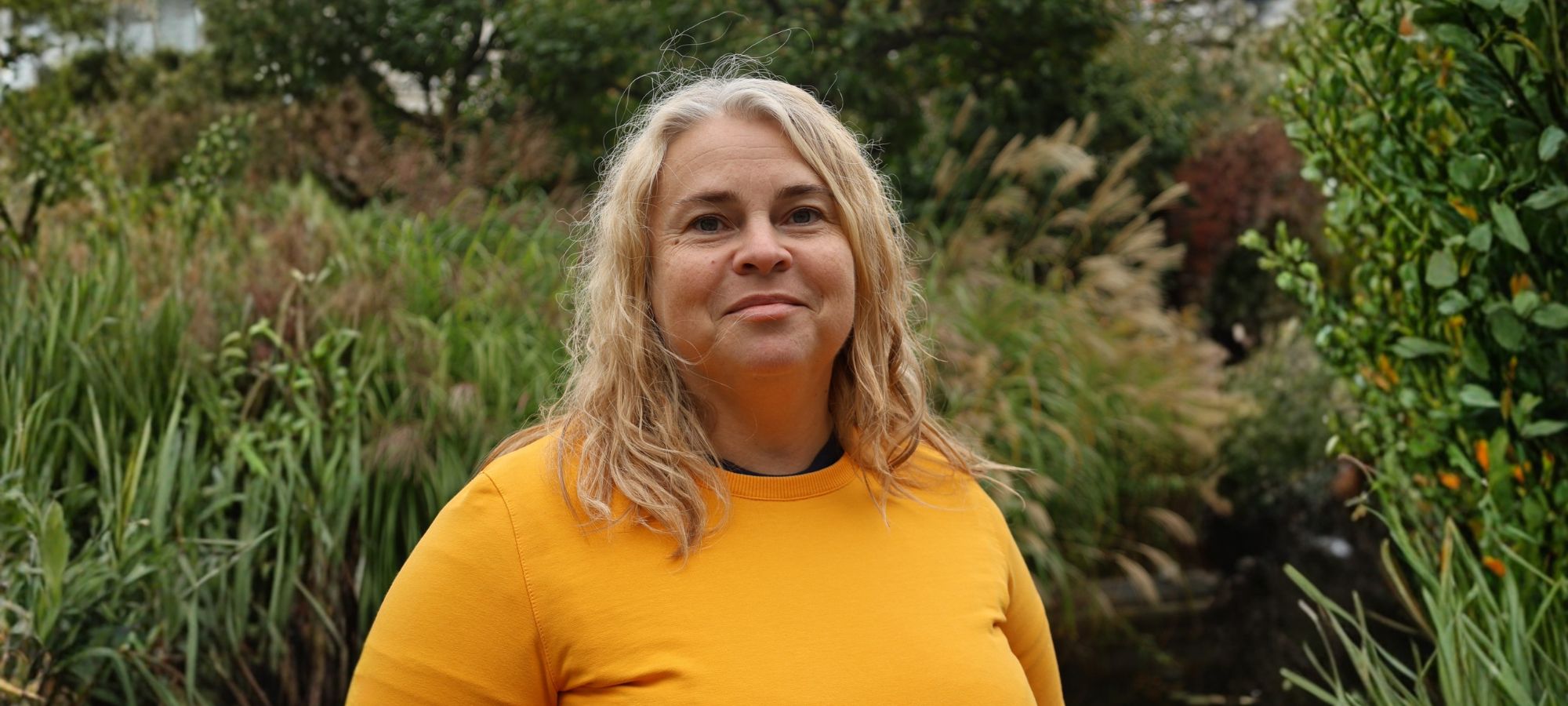
Hanna, a journalist from Ukraine on sisterhood, human rights advocacy, and peacemaking
Written by Hanna Shchydlovska in honour of the International Day for Women Human Rights Defenders
Content warning: The following article contains descriptions of war practices that might be upsetting or disturbing to some audiences.
“Strengthening the resilience of each other”
“Since 2022, the Kherson region has been partially occupied. On the right bank of the Dnipro River, there is free Ukrainian land, and on the left bank, there are Russian occupiers. The distance between the left and right banks ranges from 500 m to 5 km. From the left bank of Kherson, the occupiers shell the right bank of the region and the city with mortars and artillery. The Russian army also drops guided bombs and missiles on Kherson and hunts civilians with unmanned aerial vehicles.
Despite the danger, there are quite a few women working in our media. Three of us, including myself, work directly in Kherson and the surrounding region. We leave our families and children in neighbouring, safer areas and come to work under fire. Here, we communicate with our fellow citizens and raise their voices through our stories. We are the first to interview those affected by shelling, highlight the activities of volunteers, and their assistance to the most vulnerable categories of residents.
We tell stories about children whose childhoods are spent in basements and about women who unite to support and help each other.
We film stories and write about the work of many city services that keep it functioning. Last year, we made a documentary about demining the fields of Kherson. In it, we showed the work of combat engineers and brave Kherson farmers who cleared their fields themselves and have still been growing bread under the threat of shelling ever since.
We have taken first aid courses, we have military first aid kits, and body armour. But Russian drones filled with explosives fly in the sky above the city. For them, a person in body armour, especially one with a “Press” sticker, is target number one. That’s why we often walk around the city in ordinary clothes so as not to attract attention.
It may seem impossible, but cultural life continues in Kherson today. Performances and film screenings, art events, lectures, concerts, and master classes are now taking place in shelters.
Through our articles, videos, interviews, and documentaries, we not only bear witness to crimes against humanity but also assert our right to a normal life. After all, a city where people keep the streets clean and the flower beds blooming despite the shelling is one with a strong will and desire to defend its rights and freedoms.
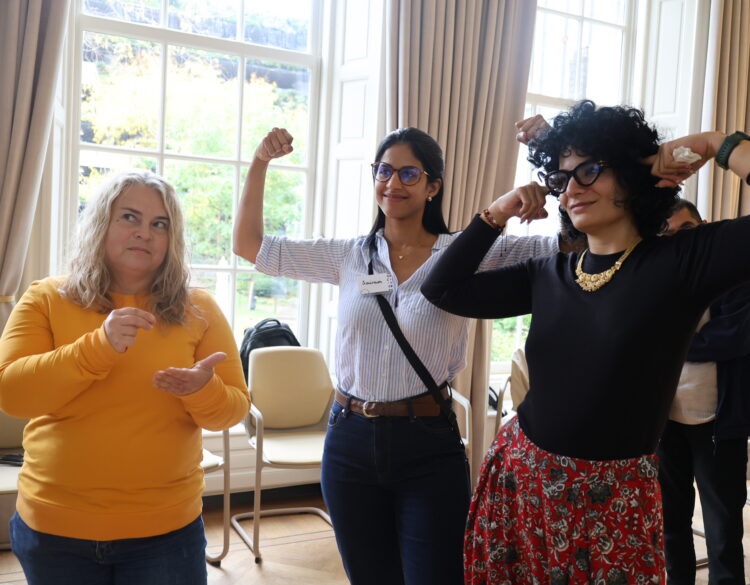
In a group of human rights defenders from other countries, brought together by the organization Justice & Peace, I saw this same desire for freedom and justice. I was particularly impressed by the strength, courage, and determination of the women human rights defenders, each with their own experiences of struggle. Despite our different stories, I noticed many similarities, felt a spirit of sisterhood, and was imbued with the Bantu African philosophy of “Ubuntu.”
The feeling of deep connection at the Shelter City human rights sessions inspired me to create. My inspiration led me to write a poem-letter addressed to a colleague and friend from the Kherson region, in which I share my realization of how each human rights defender strengthens the resilience of another.
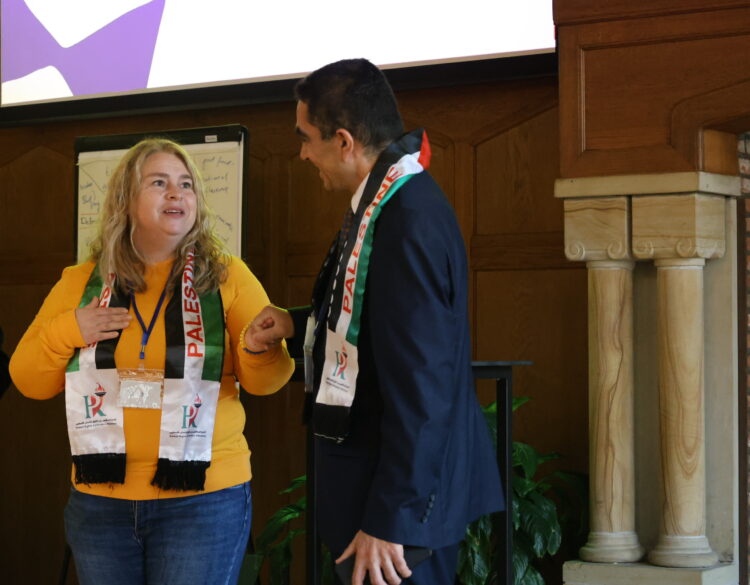
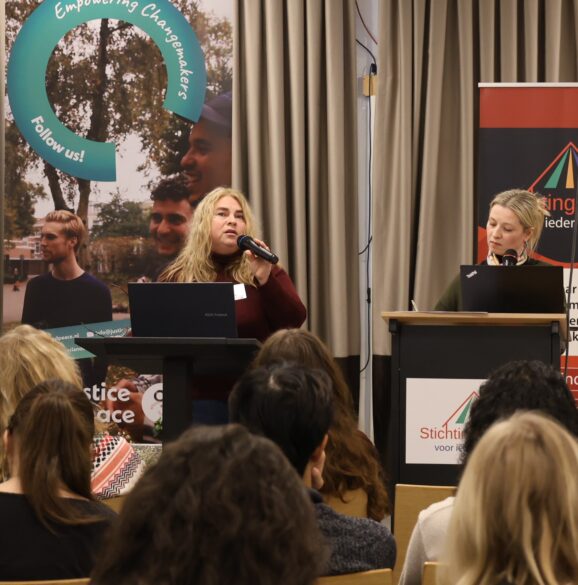
“My name is Hanna Shchydlovska, and I am a journalist for the Ukrainian media outlet Vgoru, which translates to “upward movement.” Every month, I spend two weeks back in my hometown, Kherson, which is now on the front line of the Russian invasion. Being in dangerous proximity, my colleagues and I cover the acts of defenders in today’s Kherson and document the war crimes of the Russian Federation in our region.”
Hanna was a Shelter City The Hague guest in Fall 2025.
“I am because you are”
My little girl, my woman,
you probably never were small.
You are a steadfast tin soldier
in the fragile body of a porcelain ballerina.
Let me tell you, sister, about people with fiery hearts,
like me, guests of this country of justice, where the wind of freedom blows in free sails.
Not fugitives, but creators of change who are trying
to make this turbulent world more humane.
With their grand plans, bold and unbridled dreams,
all these men and women, especially women,
seemed great to me, even majestic.
Take, for example, Adisa from Africa, Maral from Iran, Victoria and Sairam from Venezuela
so different and incredibly beautiful.
I would paint the first one on canvas
as a strong, wise, and beautiful son of Africa.
The second, a fighter for the rights of women and oppressed people,
who does not wear a hijab because she has a core and wings
capable of igniting and burning with her gaze.
The third, pure expression, a fiery Carmen, a lightning bolt
that illuminates the darkness on the path of her sisters.
And the noble beauty of the fourth,
perhaps, should be carved in marble.
Next to them all, I felt myself beautiful and worthy of everything,
even the right to rule this world.
Suddenly, left alone, I seemed to shrink,
narrowing to a dot, a speck of dust, an atom.
Can you imagine? Perhaps even self-awareness
requires the presence of another.
“I am because you are”
the Bantu African principle of humanity; “ubuntu.”
My discovery of the interconnectedness of all living things,
which explains, among other things, how we influence each other.
A new awareness of the essence of our sisterhood, my dear,
“I am because you are”…
I feel that we, women, are peacemakers by nature. I am proud that Ukraine has been running the Women, Peace, and Security programme since 2022, which aims to ensure women have equal access to decisions regarding the security, protection, and reconstruction of the country.
It is my deep conviction that only by ensuring the participation of women at all levels of statehood can we bring the world closer to the victory of democracy and the advent of lasting peace.
*You can find the original version of the poem “I am because you are” in Ukrainian here.